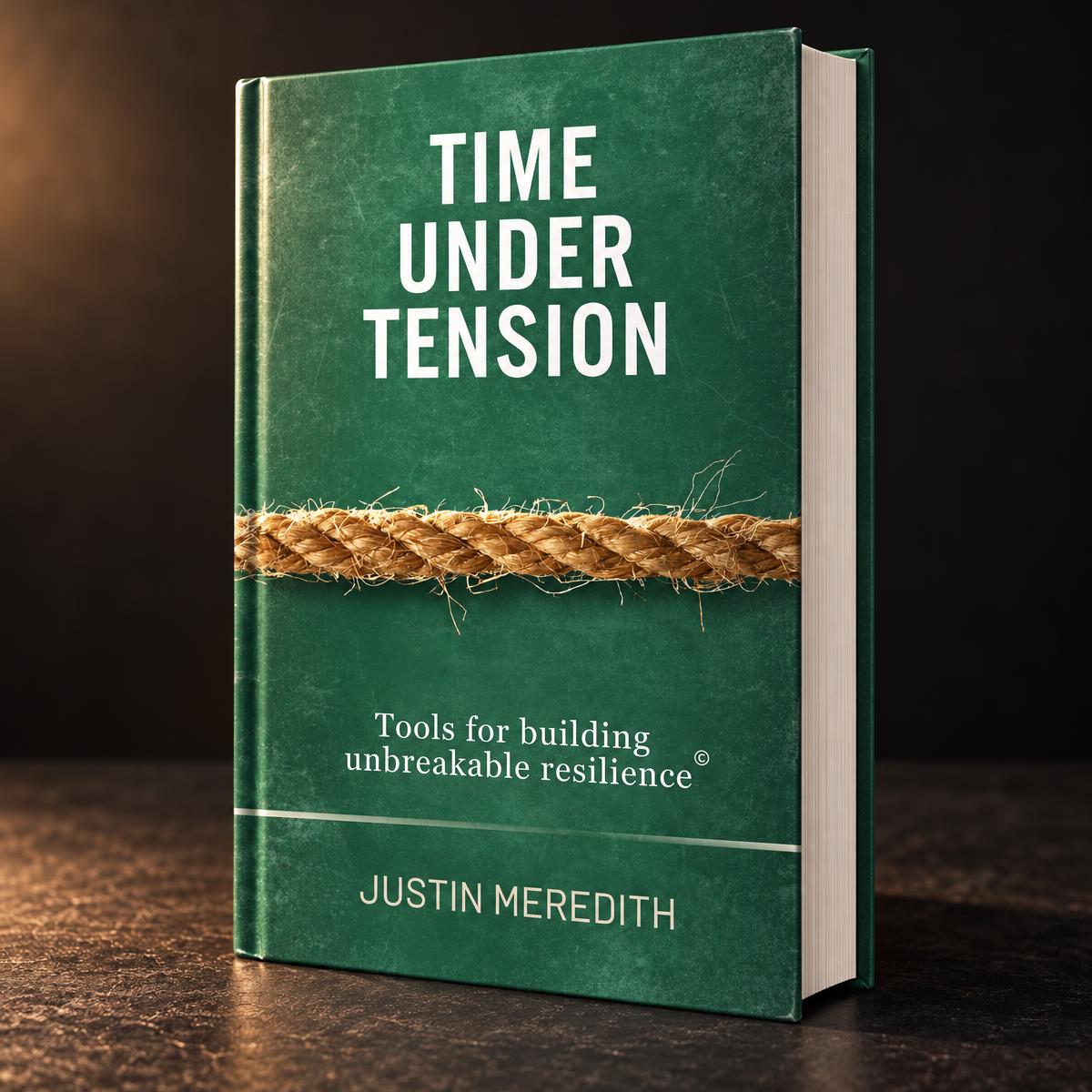
Book one · in print
Time Under Tension
Tools for building unbreakable resilience
5.0 from 3 reader ratings on Amazon
Exercises from this book ↓ Home

Two books · by Justin Meredith
Take an idea from the page into one useful practice. No sign-in or payment needed to explore the exercises.
Book one · in print
Tools for building unbreakable resilience
5.0 from 3 reader ratings on Amazon
Exercises from this book ↓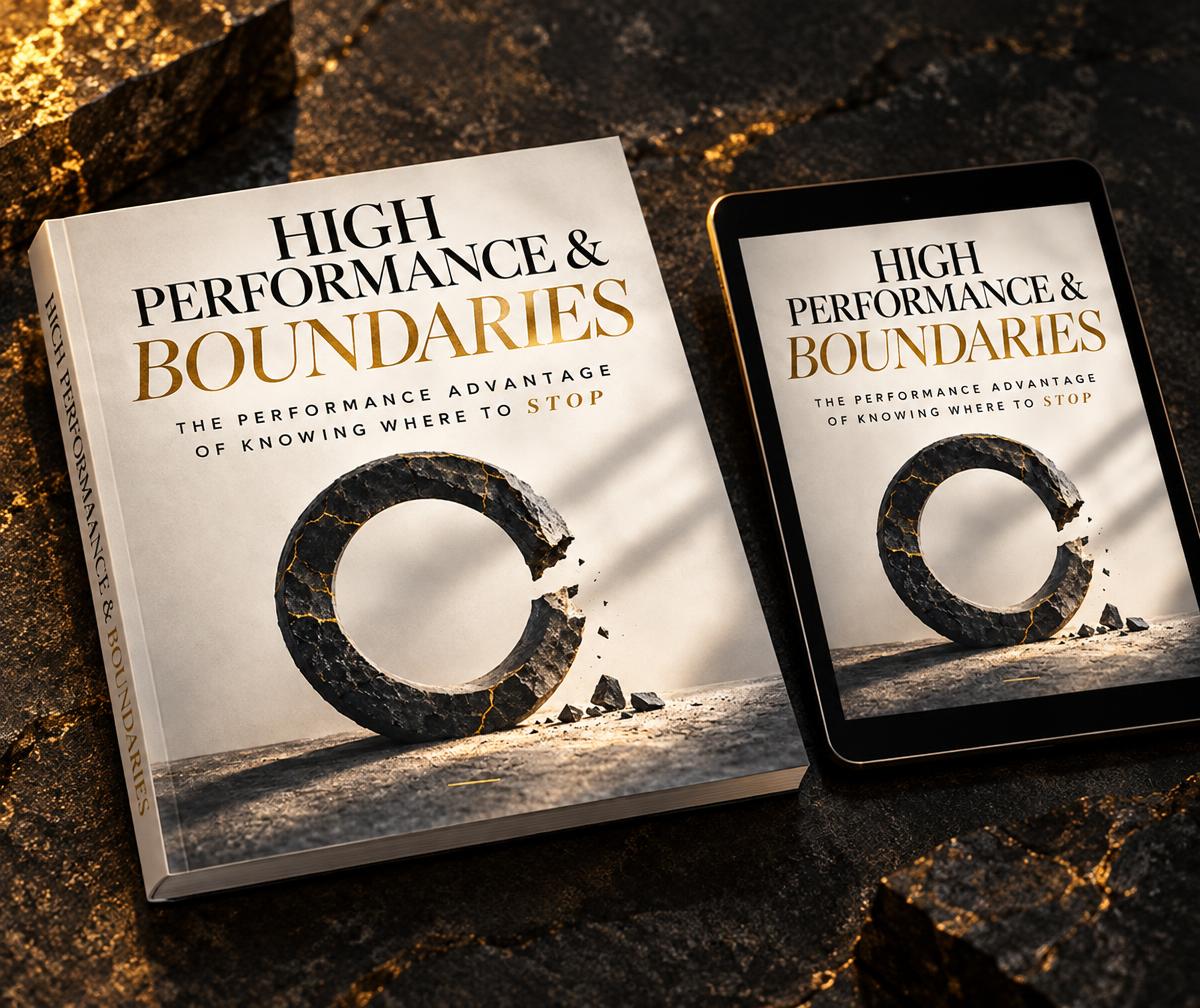
Book two · free illustrated edition
The performance advantage of knowing where to stop
90 illustrated pages. Yours to keep for an email address.
Exercises from this book ↓References below use printed page numbers, not PDF page numbers.
Printed p. 50 · Six Cs map
Explore the Six Cs in the public Arena. If you want a personal perspective, the pressure check is optional.
Explore the Six CsOptional: take a personal pressure checkPrinted p. 123
Explore control, influence and concern in the public Arena, then consider where your next useful action belongs.
Explore the ArenaPrinted p. 151
Use Credits as a related practical tool to consider what restores capacity and what draws on it in your own context.
Explore capacity with CreditsPrinted p. 154
Credits offers a related capacity exercise. It is not a software version of the book’s Bandwidth Budget and does not calculate an energy allowance.
Try the related Credits exercisePrinted p. 211
Pause, notice what is happening, consider another perspective and choose a small deliberate response.
Open the 3 Rs resetPrinted p. 221
Consider the activities that give and take capacity. The same activity can do either, depending on the situation.
Open CreditsPrinted p. 235
Bring a situation into Reconnaissance, Intent, Strategy and Execution. Build a workable plan for what comes next.
Open RISERelated companion exercise
Rehearse in the free Forge preview. This is a related practical exercise, not an exact named section of the printed book.
Prepare a conversationTHE SECOND BOOK / JUSTIN MEREDITH
The companion to Time Under Tension brings the thinking into everyday demands, limits and shared responsibility. Six selected bridges from the printed pages, not a new course. The free illustrated edition is below.
Printed pp. 3–5
Foundations, not isolation
The Six Cs make an island with connections: foundations you can return to, choices you can make and people you can ask for help. Choose one capability that fits your life now, including when things are already going well.
What deserves protecting, and who could help?
Explore the Six CsPrinted pp. 14–17
Notice what the calendar misses
Coordination, switching roles, holding an unresolved decision and anticipating someone’s needs can all draw on attention. Credits In / Out is a related way to reflect on drains and restoration, not an identical Bandwidth Budget or a measured energy allowance.
Which hidden demand could become a shared decision?
Reflect with CreditsPrinted pp. 18–27
A clear limit, a workable response
Name the request, the constraint and what you can reasonably offer. Rehearse an opening you can adapt rather than reciting a perfect script. Where a relationship or working condition is unsafe, support and changes to those conditions matter more than the wording.
What can I offer without making an impossible promise?
Rehearse a conversationPrinted pp. 28–33
Effort needs a rhythm
The ruler is a metaphor, not a reading of your physiology. Consider when to Push, Maintain or Restore in your circumstances. Recovery is part of performance, not a reward after exhaustion; changing the demand can matter as much as taking a break.
Does this moment need more effort, steadiness or restoration?
Explore your foundationsPrinted pp. 34–39
Task · Time · Test
Make the contribution clear, agree a feasible time and decide together how to check understanding or usefulness. A shared check is not surveillance. Permission to decline, fair responsibility and reciprocity keep Connect from becoming somebody else’s overload.
What would make this request clear and fair for both of us?
Explore Connect within the Six CsPrinted pp. 40–47
Carry what works into ordinary life
The book’s optional 14-day practice invites application and reflection. It is not a seventh stage or a second paid course. Keep what helped, change what did not and make room for support. A RISE plan prepares a next move; it is not proof that an action happened.
What stays, what changes and what needs support?
Prepare a next move with RISEThese are curated themes and related existing exercises, not asserted chapter titles. The second book is not a separate paid course. The Forge applies both books within its existing foundation.
JUSTIN MEREDITH / FROM THE PAGE INTO LIFE
WeRise grows from Time Under Tension: Building the Resilience Muscle and High Performance & Boundaries. The Six Cs are Justin Meredith’s original teaching synthesis. RISE and the Three Rs are routes for putting it into practice.
Connect · Control · Condition · Challenge · Choose · Commit
Start with one useful idea, free. Choose a feasible next move, including asking for help or protecting recovery. Practise in The Forge if you want to take it further.
Justin Meredith · Time Under Tension: Building the Resilience MusclePrinted pp. 47–74 · Six Cs; pp. 211–230 · Three Rs; pp. 231–254 · RISE and review
Justin Meredith · Time Under Tension: High Performance & BoundariesPrinted pp. 3–5 · Build Your Island; pp. 14–39 · capacity, boundaries, rhythm and delegation; pp. 40–47 · practice and renewal
Page ranges follow the founder-source ledger for the supplied editions. These explanations are adaptations, not verbatim quotations.
The Six Cs are Justin Meredith’s original teaching synthesis: Connect, Control, Condition, Challenge, Choose, Commit. RISE and the Three Rs connect those ideas to decisions, practice and review. The digital exercises are applications of that teaching, not the books reproduced in full.
Covey, S. R. (1989). The 7 Habits of Highly Effective People. Free Press. Habit 1.Circles of Concern and Influence: directing effort towards what can be affected. Linked reading is an Oxford teaching resource.Read the source contextWeRise’s separate inner Control ring, parking choices and prompts are adaptations, not a validated Covey assessment.
Luthans, F., Avolio, B. J., Avey, J. B., & Norman, S. M. (2007). Positive psychological capital: Measurement and relationship with performance and satisfaction. Personnel Psychology, 60, 541–572.Two studies of hope, efficacy, resilience and optimism and their relationships with performance and satisfaction.Read the source contextWeRise’s four self-reflection controls are not the Psychological Capital Questionnaire. No total, norm or validated PsyCap score is calculated.
Dweck, C. S. (2006). Mindset: The New Psychology of Success. Random House.Beliefs about whether abilities can develop; a basis for examining “I can’t”.A change in wording alone does not establish growth or remove material constraints.
These origins do not independently validate the WeRise synthesis, digital programme or diagnostic measures. General science is not exclusive WeRise IP. Harmful conditions may need practical change or qualified support, not another personal technique.
Text-led teaching is available now. A founder recording is not yet available. No recording, transcript or exact quotation is implied.
Explore research and limitationsThe companion edition
The chapter that did not make it into Time Under Tension, expanded into a 90-page illustrated edition.
Free illustrated edition · PDF
Fourteen chapters on bandwidth, saying no without guilt, guarding your focus and keeping the island. Leave your email and the book is yours to keep.
A separate perspective · for leaders
Look at the conditions making work harder. One person’s perspective is not a team score, and individual assessment scores are not team scores.
Explore pressure at work